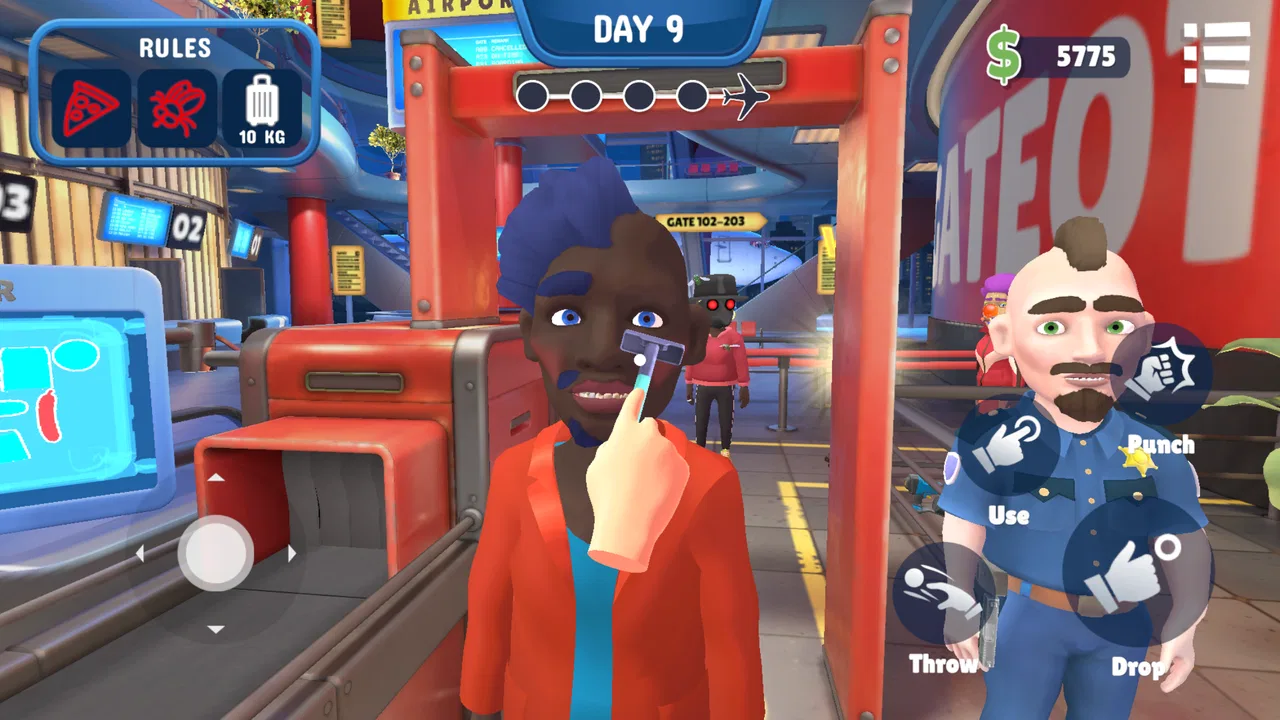
I Am Airport Security
- 4.4
- Rating
- 1.00M
- Installs
- Free
- Price

 Analysis by App-foxy
I Am Airport Security caught my attention because it turns a familiar travel checkpoint into a role-playing game built around judgement. Instead of simply passing through an airport, I take the position of the person deciding who may continue toward the plane. That change in viewpoint gives the game an immediately understandable premise, but the real question is whether the decision-making stays interesting after the first few rounds.
Estoty presents it as a free game for Android, with a teen content rating and support beginning with Android 8.0. It sits in the role-playing category rather than presenting itself as a serious security simulator, so I approached it as a light, situational game with a workplace theme. That distinction matters: the appeal is less about learning real airport procedures and more about handling a stream of questionable situations inside a simple interactive scenario.
The game is currently at version 1.0.0, and its store presence shows over 500 thousand installs with an average rating of 4.4 from around 1.3 thousand ratings. Those figures suggest that the central idea connects with a sizeable audience, although they do not tell me whether every player will enjoy the pace or the amount of repetition. My own recommendation is fairly direct: if you like games where small choices create immediate consequences, this is worth trying; if you want a deep role-playing system with extensive character development, you may find it too narrow.
You May Also Like

 Blood Strike: 2.5 Anniversary
Blood Strike’s Loadouts Turn Every Drop Into a Tactical Gamble
A close look at Blood Strike’s custom loadouts: how fast access to signature weapons reshapes its battle royale rhythm, rewards preparation, and narrows the gap between fights.

 Pandora - Music & Podcasts
Pandora’s Music Is Easy to Start, but Harder to Recover
Pandora’s strength is its low-effort path from a seed to a station. Its weak spot is how much confidence it asks you to place in connection, setup, and quiet recovery.

 8 Ball Pool
 Is Built on Rivalries, Rematches, and Routine
A close look at the rivalries, rematches, shared routines, and unanswered safety questions that turn a quick pool match into a persistent mobile community.

 Samsung Music
’s Quiet Strength Is Playing What You Already Own
Its reach comes less from spectacle than from dependable access to a personal library. That simplicity is both the app’s strongest retention engine and its ceiling.

 AccuWeather: Weather Radar
AccuWeather Review: A Quick, Clear Forecast for Everyday Decisions
For everyday plans, the best forecast is the one you can understand quickly. AccuWeather makes rain timing, radar, and local conditions easy to act on, with a few trade-offs.

 Hill Climb Racing
Why Hill Climb Racing Still Turns Crashes Into One More Run
A tiny car, a bumpy hill and one more upgrade: Hill Climb Racing keeps resurfacing because its simple chaos makes every near-miss feel personal.
More From Our News Desk
View All News


Getting past the first points of friction
The first obstacle with a game like this is not necessarily the decision-making itself. It is understanding what the game expects me to notice. Airport security is a visually familiar setting, but familiarity can work against the player because I may assume that every clue is obvious. In practice, I found it more useful to slow down, read the situation carefully, and avoid treating the first suspicious detail as an automatic reason to reject someone.
That is the first practical habit I would suggest to a new player: separate what is clearly presented from what merely feels unusual. A person, document, or situation can look suspicious without the game necessarily asking for the harshest response. I get better results when I inspect the available information in order instead of tapping through quickly and hoping the correct choice becomes clear.
Another common source of frustration is expecting the opening moments to explain every rule at once. A compact mobile game often teaches through short interactions rather than a long manual. If an early decision goes badly, I do not treat that as proof that the game is broken. I use it as a signal to pay attention to the wording and visual cues on the next attempt. This is especially important for players who normally prefer action games and may instinctively rush.
The most useful early strategy is to treat each encounter as a checklist, not a reflex test. I look at the person, review the information placed in front of me, consider whether the details agree, and only then choose a response. That approach makes the game feel less random and also reduces the temptation to replay the same moment without learning anything from it.
What to check before blaming the game
Because I Am Airport Security is free, it is easy to install it casually and assume that any awkward start must be a software problem. Before drawing that conclusion, I would make a few simple checks. I would confirm that the phone is running Android 8.0 or later, leave enough free storage for the installation process, and make sure the game has finished updating before judging its performance. A device that technically meets the operating-system requirement can still struggle if it is overloaded with background apps.
I would also restart the game after an interrupted installation or an unusually long loading pause. That is ordinary troubleshooting, but it is useful here because a partially completed setup can make a game appear unresponsive when the real issue is simply that the installation did not finish cleanly. If the store page shows an available update, applying it before beginning a serious play session is sensible, particularly while the game remains at an early version.
Players should also check their control habits. If taps seem not to register, I first try pressing the centre of the visible option rather than the edge. I avoid rapidly tapping several choices in succession, since that makes it difficult to tell whether the game ignored an input or accepted an earlier one. A clean, deliberate tap is a small change, but it helps distinguish interface confusion from a genuine fault.
There is another setup detail worth considering: the teen rating. That does not tell me that the game is unsuitable for every younger player, but it does mean parents should review the experience themselves before handing over a device. The rating is a useful reminder that the airport-security theme may include tension or situations that are not designed as a preschool-style game. I would not choose it automatically for a very young child simply because the controls look approachable.
The game is free to download, while in-app purchases are listed at $2.99 per item. I would keep that in mind before letting a child play without supervision. The price is not a reason to avoid the game, but it is a reason to understand the purchasing environment on the device. For my own use, I would play the opening sessions without spending anything and decide whether the basic loop is enjoyable before considering an optional purchase.
A calmer workflow makes decisions clearer
Once the game is running properly, the best way to play is to establish a repeatable workflow. I begin by identifying what the current encounter is asking me to decide. Then I scan the available details from left to right or top to bottom, rather than jumping toward the most dramatic-looking element. This prevents one eye-catching clue from dominating the entire decision.
I also try to remember the difference between speed and efficiency. Moving quickly can feel satisfying, but a rushed choice is not necessarily a good choice. The game’s airport setting naturally encourages a queue-management mindset, yet I do not assume that the fastest possible response is always the intended one. A short pause to verify the information often feels more productive than immediately selecting an answer and replaying after a mistake.
When I make an incorrect decision, I avoid restarting blindly. Instead, I ask what changed between the correct and incorrect interpretation. Was I reading the wrong detail? Did I overlook a contradiction? Did I assume that a suspicious appearance was enough? This kind of self-review is one of the more interesting parts of the experience because it turns a simple tap-based interaction into a small exercise in attention.
For players who find the pace stressful, I recommend playing in short sessions. A few encounters while waiting for a bus or taking a break can be more enjoyable than forcing a long session after concentration has faded. Airport-screening decisions depend on noticing small differences, and tired players are more likely to miss them. Short sessions also make repetition less noticeable.
For players who prefer a challenge, I would impose a personal rule: do not make a decision until every visible piece of information has been checked. That rule is not a feature of the game; it is a way to get more value from the design. It changes the experience from guessing which option looks safest into practising consistent judgement. I found that approach particularly useful when the obvious answer seemed too easy.
Recovering when a session goes wrong
Every player eventually reaches a point where a decision feels unfair, a mistake seems impossible to undo, or progress does not behave as expected. My first response would be to finish the current interaction if the game still accepts input. Repeatedly closing and reopening the app in the middle of a decision can make it harder to know whether the problem came from the game, the device, or an interrupted action.
If the interface becomes stuck, I would close the app normally, reopen it, and try the same section with slower taps. I would also restart the phone if the issue continues, especially when other apps have been running for a long time. These are intentionally general steps: they address common mobile problems without assuming a particular save system, account system, or permission setup that has not been established for this game.
If a choice seems to produce an unexpected result, I would replay the situation while changing only one thing. For example, I might read the information in a different order but keep the final decision the same, then compare the outcome. Changing one variable at a time is more useful than tapping every option randomly because it reveals whether the problem is a misunderstanding or a repeatable software issue.
It is also worth checking whether the phone is registering touches accurately. A screen protector, damp fingers, or a damaged area of the display can create missed inputs that look like game errors. I test other buttons or apps briefly before deciding that the airport interaction itself is at fault. If the same part of the screen fails elsewhere, the game may simply be exposing an existing device problem.
Another sensible recovery step is to avoid clearing app data impulsively. Removing local data can erase progress in games that store progress on the device, and I would not do that unless I had accepted the risk. I would try a normal restart and a device restart first. If the issue remains, the safest next step is to use the app’s official support route or the relevant app-store support tools rather than relying on guesses from unrelated games.
When the problem is really the device or the setting
Not every disappointing session points to a defect in I Am Airport Security. A phone that is low on free space, heavily loaded with background processes, or running hot can make any game feel sluggish. I would close demanding apps, let the device cool down, and try again before forming an opinion. If performance improves, the limitation was probably environmental rather than specific to the game.
Connectivity can also confuse the diagnosis. Some mobile games need an internet connection for parts of their operation, while others work more independently, and I would not assume one behaviour without testing the situation. If something fails only when the connection changes, I would try a stable network and compare. That simple comparison tells me more than repeatedly pressing the same button offline.
Notifications and interruptions deserve attention too. A call, message, battery warning, or system overlay can interrupt a decision at exactly the wrong moment. I prefer to play with unnecessary interruptions reduced, especially when I am trying to judge whether the game’s workflow is fair. This is not about demanding a perfect phone; it is about giving the game a consistent test instead of mixing interface interruptions into the review.
The same applies to expectations. If I install this hoping for a full airport-management simulation, I may interpret its focused interactions as missing content. If I install it as a casual role-playing game about making screening decisions, the compact design makes more sense. The game is not automatically failing because it does not behave like a management simulator, puzzle collection, or large adventure role-playing title.
Where it fits among role-playing games
Compared with conventional role-playing games, this one places less emphasis on exploring a world, improving a hero, collecting equipment, or building a party. Its appeal comes from the role itself: I am placed behind the checkpoint and asked to judge situations. That makes the game easier to pick up than a large role-playing adventure, because I do not need to learn a complicated character build before I can understand the basic purpose.
The trade-off is depth. Players who enjoy long stories, tactical battles, open maps, or detailed progression systems will probably find more satisfaction in a traditional role-playing game. I Am Airport Security is better suited to someone who wants a contained decision-making loop that can be understood quickly. It is also a more natural fit for short breaks than a game that expects a long uninterrupted quest.
It differs from ordinary puzzle games in an important way as well. The challenge is not only to identify a matching shape or solve a fixed logic grid. The airport context gives each decision a social and procedural flavour. I have to interpret a situation and accept that my choice carries responsibility within the game’s setting. That makes the experience more approachable than an abstract puzzle for some players, while making it less satisfying for anyone who prefers purely mathematical problems.
It also does not replace a serious travel or security guide. I would not use it to learn real airport rules, document requirements, or professional screening practice. The role-playing label is the useful clue here: the game offers an imagined job scenario for entertainment, not practical certification. That boundary is important, especially for players who might otherwise read game logic as real-world advice.
Who will enjoy the checkpoint role?
I think the strongest audience is made up of players who enjoy observation, quick interpretation, and the feeling of making a call with limited information. It can also work well for someone who wants a game that is easy to explain to a friend: one person takes the security role, examines the presented situation, and decides who should proceed. The premise is specific enough to feel different without requiring a large amount of background knowledge.
It is a good choice for casual play when I want a clear objective rather than an open-ended sandbox. I can approach it with a focused mindset, play for a while, and stop without needing to remember a complicated plot or manage a large inventory. That simplicity is a genuine strength on a phone, particularly for people who do not have the patience for lengthy tutorials.
I would be more cautious about recommending it to players who dislike repeated decision patterns, who want extensive customisation, or who become frustrated when a game expects careful reading. Someone looking for a competitive multiplayer experience should also choose something else. The appeal here depends on the checkpoint scenario remaining engaging, and that will vary sharply between players who enjoy procedural judgement and those who need constant action or exploration.
Parents should consider both the teen rating and the purchase setting before recommending it to a child. Adults who enjoy playing alongside a younger family member may find the premise easy to discuss, but I would still review the tone personally first. The game’s simple interaction style does not automatically make it a child-focused title.
My practical verdict after weighing the friction
My overall view is positive but measured. I Am Airport Security has a clear identity, and that is valuable in a crowded role-playing category. The airport checkpoint perspective gives ordinary taps a reason to exist, while the need to inspect details adds more involvement than simply choosing the most obvious button. I especially like it when I play slowly enough to make each decision deliberately.
Its limitations are tied to the same focused design that makes it approachable. Players expecting deep character progression, a broad simulation, or a large narrative may feel that the concept does not expand far enough. The early version also gives me a reason to keep expectations realistic: I would judge the game by the quality of its central checkpoint loop rather than by features associated with much larger role-playing productions.
Estoty is offering the game free of charge, with optional purchases priced at $2.99 per item. I would start without spending money, confirm that the basic sessions hold my attention, and keep purchase controls in mind on shared devices. That approach lets the game prove its value through play rather than through the promise of extras.
For a friend who likes compact mobile games, unusual job-based premises, and decisions that reward attention, I would recommend giving it a try. I would tell a friend who wants a deep fantasy adventure or a realistic airport simulator to skip it and choose a game built around those goals instead. In the right mood, the checkpoint role is engaging precisely because it asks me to notice before I act. That small pause between suspicion and decision is where the game has its best idea.
FAQs for I Am Airport Security
01What is the main objective of I Am Airport Security?
In I Am Airport Security, players assume the role of an airport security officer, with the primary aim of maintaining safety and order at an airport. You will be responsible for checking passengers, scanning luggage, and ensuring that no prohibited items make it through security. It's a blend of strategy and time management.
02Is I Am Airport Security available on both Android and iOS?
Yes, I Am Airport Security is available for download on both Android and iOS platforms. You can find it on the Google Play Store for Android devices and the Apple App Store for iOS devices. Make sure to check your device compatibility before downloading.
03Are there in-app purchases in I Am Airport Security?
I Am Airport Security does offer in-app purchases. These purchases can enhance your gameplay experience by providing additional resources, upgrades, or cosmetic items. However, the game can still be enjoyed without making any purchases, as these are optional and not required to progress.
04How does the game handle difficulty progression?
The game gradually increases in difficulty as you advance through levels. Early stages serve as a tutorial to familiarize you with the controls and security procedures. As you progress, the scenarios become more complex, with higher passenger volumes and more challenging security situations to manage.
05Can I play I Am Airport Security offline?
Yes, I Am Airport Security can be played offline, making it convenient for users who may not have constant internet access. However, certain features, such as leaderboards or purchasing in-game items, may require an internet connection to function properly.
Pros
- Engaging gameplay with realistic scenarios.
- Intuitive controls make it easy to navigate.
- Diverse levels keep the game fresh.
- Visually appealing graphics enhance experience.
- Regular updates add new content.
Cons
- Ads can interrupt gameplay frequently.
- Limited customization options available.
- Some levels may feel repetitive.
- In-app purchases can be costly.
- Occasional glitches in specific levels.

I Am Airport Security
Gallery